 Botswana Mining Review Comprehensive Coverage of the Progress and Achievements in the Mining Sector


Related Articles


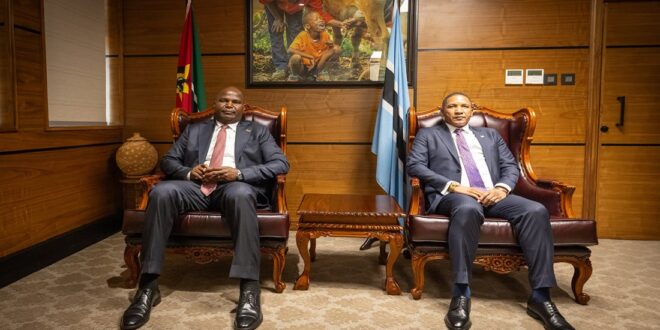
Fifty-one years of diplomatic ties are taking on a more commercial dimension as Botswana and Mozambique seek to convert long standing political solidarity into deeper cooperation in minerals, energy, trade and strategic infrastructure.
The direction emerged during Mozambican President Daniel Francisco Chapo’s three-day State Visit to Botswana, which coincided with Botswana’s 60th Independence celebrations. The visit placed a stronger economic focus on a relationship historically shaped by solidarity and Mozambique’s support for Botswana during the liberation struggle.
At the centre of the new agenda is the establishment of the Botswana–Mozambique Bi-National Commission, creating a high-level mechanism to oversee bilateral cooperation and accelerate implementation of agreements and joint initiatives. For the two mineral-rich economies, mining presents an important area for closer collaboration. Botswana’s diamond industry has evolved beyond extraction into marketing, cutting and polishing, while Mozambique brings a broader resource base and growing ambitions across its mining and energy sectors.
President Chapo’s visit to the Okavango Diamond Company offered a practical window into Botswana’s diamond value chain, with the delegation receiving a briefing on ODC’s role in the marketing and distribution of the country’s rough diamonds. The engagement also provided an opportunity to explore how natural resources can generate greater economic value through stronger regional partnerships.
Energy offers another strategic point of convergence. Botswana is looking to deepen cooperation with Mozambique as the latter expands its hydropower capacity, while Mozambique’s role in regional fuel supply and infrastructure also creates opportunities for closer energy integration. President Duma Boko has highlighted Mozambique’s hydropower expansion and the strategic importance of the Matola Port oil storage hub to regional energy security.
The broader economic agenda extends to transport and logistics, with both countries seeking to improve connectivity and unlock trade. Mozambique’s government has also identified logistics and transport, agriculture and agro-processing, tourism and industrialisation as platforms through which the two economies can build more concrete commercial links. Chapo has called for the relationship to move from political understanding towards concrete economic projects, arguing that the countries should use their complementary economic strengths to expand trade, investment and private-sector opportunities.
For Botswana, the partnership offers access to a coastal economy with strategic energy, logistics and port infrastructure. Moreover, for Mozambique, closer engagement with Botswana opens opportunities to deepen links with a stable regional economy and a mining sector with an established international diamond footprint. The establishment of the Bi-National Commission provides the institutional framework for more efficient regional trade.
