 Botswana Mining Review Comprehensive Coverage of the Progress and Achievements in the Mining Sector


Related Articles
The government of Botswana used its debut Country Showcase at African Mining Indaba to send a clear message that the next chapter of its mining story will be defined by value addition, diversification and strategic partnerships. From diamonds to copper and critical minerals, the country is repositioning itself not just as a resource-rich nation but as a 21st century mining leader.
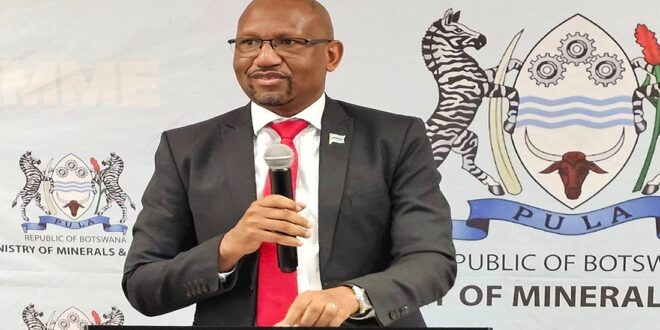
Opening the session, Ministry of Minerals and Energy’s Permanent Secretary Pelaelo Khowe reflected on Botswana’s 55 year mining journey, a story that transformed the country from one of the world’s poorest at independence into an upper-middle-income economy. But the future, he emphasised, must go beyond extraction.
Botswana is focused on increasing local value addition, strengthening inclusive value chains and advancing manufacturing linked to mining. Policy reforms and frameworks are being refined to ensure African countries better harness their resources through diverse economic models, responsible governance and joint commitments to industrialisation. The objective is to create jobs, build upstream and downstream industries, attract capital and ensure resources are extracted responsibly.
The Botswana Geoscience Institute’s Chief Executive Officer, Olefile Cisco Mashabila, described the country as entering a “Transformation Era” under President Duma Boko’s leadership. He framed the current global environment as a VUCA world( volatile, uncertain, complex and ambiguous) but argued that Botswana’s stability gives it a competitive edge amid the critical minerals surge.
Mashabila noted, “The country’s recent legislative reforms are designed to positively disrupt the sector, encourage responsible mining and elevate mine rehabilitation standards. Government-led initiatives such as the 2025 aeromagnetic survey are unlocking new geological insights, particularly in the highly prospective Kalahari Copperbelt (KCB).”
Botswana’s transparent mining cadastre system, a globally accessible, one-stop digital portal offers investors clarity and confidence. With Fraser Institute rankings consistently above 60%, the country remains one of Africa’s most attractive exploration jurisdictions. “Botswana is fertile ground for minerals,” said Mashabila, highlighting untapped critical mineral potential and calling on investors to partner and help diversify the sector beyond diamonds.
Sandfire Resources Chief Executive Officer, Jamie Caratti presented Motheo Copper Mine as a case study in what partnership can achieve. In production since 2023, Motheo represents Botswana’s diversification drive in action. The operation employs around 1,900 people, 95% of them local and has contributed approximately P4 billion to the economy.
Built to global technological standards, Motheo integrates sustainability, community development, women’s empowerment and youth education initiatives into its operating model. Sandfire is also investing in targeted exploration in the Kalahari Copperbelt, using AI-assisted tools to identify additional mineralisation. “Sandfire has demonstrated what is possible in Botswana through partnership,” stated Caratti.
A fireside chat moderated by Minerals Development Company Botswana (MDCB)’s Esther Norris brought together De Beers CEO Al Cook and Botswana’s Minister of Minerals and Energy, Bogolo Kenewendo. The discussion reflected on Botswana’s landmark partnership with De Beers, now one year into its renewed agreement, widely regarded as one of the most successful public-private mining collaborations globally.
Kenewendo described Botswana’s journey as “a story of ingenuity and resilience,” noting that the partnership has positioned the country to capture greater value and strengthen its credibility in global markets. Beyond diamonds, Botswana is focusing on copper, high-grade iron ore, platinum and other minerals, alongside growing its jewellery manufacturing industry and advancing technology-driven mining projects.
“Traceability, aggressive marketing, consumer education and beneficiation are central to the next phase. Initiatives such as the Okavango Blue diamond, marketed through the Okavango Diamond Company, tell a uniquely Botswana story, linking biodiversity, ethical sourcing and premium value. The country’s approach to mining-wildlife coexistence around areas like the Okavango Delta further reinforces its positioning as a leader in responsible and ethical production,” said Kenewendo.
Cook noted that while the longevity of the Botswana–De Beers partnership may have been inevitable, its success was built on equity and shared value. The renewal signals confidence in a model that has turned what many call the “resource curse” into a blessing, a development success story, supporting free education, infrastructure and long-term economic growth.
He added that De Beers’ role in Botswana is expanding beyond extraction, supporting skills development, technology advancement and broader investment structures designed to position Botswana as a global mining leader. Even modern marketing moments from high-profile celebrity placements to global branding campaigns reflect a 21st century strategy to keep Botswana’s diamonds emotionally relevant to consumers worldwide.
The showcase closed with a forward-looking question: what’s next? Kenewendo shared that Botswana is now focusing on growth through exploration, greater value addition, regional partnerships and integration into global supply chains. She concluded,” Botswana is not resting on its diamond legacy. It is actively building the next frontier of mining, anchored in governance, diversification, technology and shared prosperity. In a shifting global minerals landscape, Botswana is positioning itself not just as a participant but as a pace-setter.”
