 Botswana Mining Review Comprehensive Coverage of the Progress and Achievements in the Mining Sector


Related Articles


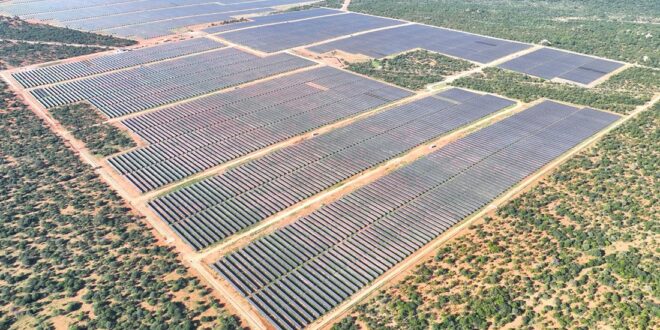
Botswana’s energy transformation reached a defining milestone on 28 August 2026, when Minister of Minerals and Energy Bogolo Joy Kenewendo officially launched the country’s first large scale renewable energy project, the Mmadinare 100MW solar PV plant. The facility forms part of the Integrated Resource Plan for electricity, the national generation strategy aimed at lifting renewable energy’s share of the power supply from 2% to at least 50% by 2030.
That target is proving less aspirational than it once appeared. The Mmadinare solar cluster, alongside other operational solar projects in the country, is already supplying more than 209MW of clean electricity, accounting for roughly 30% of Botswana’s daytime power supply. At the launch, Kenewendo framed the plant as something larger than an addition to generation capacity, describing it as tangible proof of the government’s commitment to strengthening energy security, diversifying the energy mix and accelerating the shift toward a cleaner energy future. She positioned the expansion of solar power as the cornerstone of Botswana’s renewable energy roadmap to 2030 and reaffirmed the government’s intent to ensure energy investment translates into meaningful economic opportunity for Batswana.
Kenewendo said the Integrated Resource Plan remains the foundational framework guiding Botswana’s transition toward a cleaner, more reliable and environmentally responsible energy system, one designed to balance energy security, economic growth and environmental protection. Reliable energy, she argued, is central to the country’s broader economic ambitions, from attracting industrial investment and enabling enterprise growth to creating employment and reducing dependence on imported electricity, all while retaining greater value within the domestic economy. The improvement in domestic generation is already reshaping Botswana’s position in the region. With the 100MW Mmadinare Solar PV Cluster now fully operational, Kenewendo highlighted that increased generation capacity is improving electricity stability, strengthening energy security, attracting investment and opening the possibility for Botswana to become a net electricity exporter in the region. She noted that supply has improved markedly since Morupule B Power Station’s four units became fully operational and that the 100MW Jwaneng solar PV cluster and Morupule A are also now contributing, sharply reducing the country’s reliance on imported electricity.
Member of Parliament for Mmadinare and Minister of Local Government and Traditional Affairs, Ketlhalefile FC Motshegwa, placed the project within the context of Botswana’s natural resource endowment, noting the country’s exceptionally high levels of solar radiation. He said leveraging that resource gives Botswana a genuine opportunity to shift toward a sustainable energy mix and position itself as a net electricity exporter within the region. Botswana Power Corporation (BPC) Chief Executive Officer David Kgoboko reported that the Mmadinare plant has already generated more than 243,288MWh of electricity since commissioning, helping supplement domestic generation and reduce costly imports from the Southern African Power Pool. He said the plant has maintained availability and reliability averaging above 99%, a performance he described as a testament to both the quality of the facility and the strength of the partnership between BPC, government and private investors. The project was financed, developed and constructed by Scatec, which will also operate and maintain the plant under a 25 year power purchase agreement with BPC as offtaker.
