 Botswana Mining Review Comprehensive Coverage of the Progress and Achievements in the Mining Sector


Related Articles

Giyani Metals Corp. reported robust financial prospects for its flagship K.Hill battery-grade manganese project in Botswana, marking a pivotal step toward establishing a rare, non-Chinese source of a critical electric-vehicle battery material.
A definitive feasibility study (DFS) for the 100%-owned development project yielded a post-tax net present value of $481.5 million, assuming an 8% discount rate, and a post-tax internal rate of return of 20.3%, the Toronto-listed explorer said in a statement. The study projects the open-pit asset will generate $1.6 billion in net free cash flow over its operating lifespan, maintaining a lucrative 46% operating margin.
The economic validation comes at a critical juncture for Western automakers trying to build supply chains independent of Beijing. China currently controls roughly 95% of the world’s processing capacity for high-purity manganese, leaving the global transition to energy storage and electric vehicles highly vulnerable to geopolitical friction.
“These results demonstrate strong economic returns and endorse K.Hill as a unique, mine-to-market battery-grade supplier of manganese to meet growing Western demand,” said Nigel Robinson, Giyani’s interim executive chairperson.
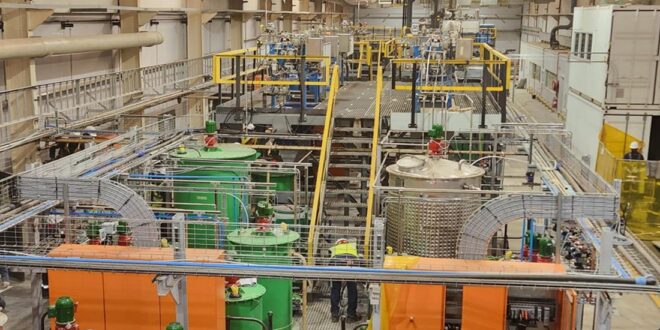
The proposed processing facility is designed to churn through 220,000 tonnes of dry run-of-mine ore per year. It will specialize in dual premium products: high-purity manganese sulphate monohydrate (HPMSM) and high-purity manganese oxide (HPMO), both essential building blocks for high-performance EV batteries. Giyani successfully proved its commercial processing flowsheet earlier via a demonstration plant built in Johannesburg, South Africa.
There remains substantial upside to the asset’s current lifespan. Giyani noted that 4.4 million tonnes of inferred resources were entirely excluded from the baseline feasibility study, giving the company a clear avenue to extend the mine’s operations and high-grade production profile in future expansions. Currently, the plant boasts a manganese recovery rate of 87%.
Looking ahead, Giyani is pivoting to engineering refinements and cost-cutting initiatives. The company plans to optimize the plant’s layout, evaluate lower-carbon reagents, scale up international procurement, and integrate more solar power to shield the project from rising energy costs and minimize its carbon footprint.
With the technical blueprint now established, the company’s focus turns squarely to commercialization and funding.
“With China controlling 95% of manganese processing capacity, access to non-China supply of this critical material is constrained,” Robinson said, adding that Giyani will now be “progressing its discussions with strategic partners and evaluating opportunities within the battery-grade manganese sector.”
