 Botswana Mining Review Comprehensive Coverage of the Progress and Achievements in the Mining Sector


Related Articles



In an environment defined by geopolitical tension, energy uncertainty and infrastructure constraints, logistics is rapidly becoming a key differentiator in mining by shifting from a support function to a source of competitive advantage. As commodity markets grow more volatile, mining companies are increasingly judged not only on what they produce but on how reliably and efficiently they can move it from pit to port.
According to Standard Bank Africa’s Mining Value Chains Indaba 2026 report, South Africa’s mining sector continues to underpin the economy, contributing an estimated 6% to 7% to gross domestic product and accounting for more than half of merchandise exports. However, the next phase of growth will depend less on extraction volumes and more on the performance of integrated value chains. “We’re increasingly seeing geopolitical tensions impacting global energy markets, with infrastructure constraints closer to home placing our mining supply chains, among other logistical factors under pressure. Against the backdrop of this market volatility, operational continuity is ultimately reliant on experienced logistics partnerships,” commented Duhan du Plessis, Group Marketing Manager at Reinhardt Transport Group.
Volatility shifts focus to supply chain performance. Recent geopolitical developments including tensions in the Middle East and disruptions in the Strait of Hormuz, are introducing new risks into global energy markets. For African producers reliant on imported fuel, these dynamics are translating into cost volatility, supply uncertainty and rising pressure on transport economics. “Energy costs are a critical pressure point as mining operations are energy-intensive, with fuel price volatility affecting on-site extraction, long-haul transport and port handling. These cost pressures are felt across the entire export chain, with freight rates, delivery timelines and even global competitiveness being impacted,” explains Du Plessis.
At the same time, demand for critical minerals such as manganese and chrome is increasing, placing additional pressure on logistics systems that are already operating near capacity. Domestically, infrastructure constraints continue to shape performance. While improvements such as reduced loadshedding and growing private sector participation are supporting recovery, rail inefficiencies remain a structural bottleneck. “There are encouraging signs of recovery such as the absence of loadshedding and private investment but rail underperformance and capacity constraints are still a bottleneck for bulk commodity exporters, with coal one of the commodities impacted.”
Although rail volumes are gradually improving, they remain below historical benchmarks, sustaining reliance on road freight and increasing the importance of integrated corridor strategies. Reforms such as opening the rail network to private operators and separating infrastructure management from train operations are expected to enhance long-term capacity. However, their impact will depend on consistent execution and sustained investment.
Operational integration becomes the new advantage. “In this environment, the efficiency of mine-to-port logistics corridors has become a critical determinant of export reliability. Logistics providers with established corridor experience, regulatory insight, state-of-the-art security, fleet scale and operational depth play a critical role in maintaining supply chain continuity,” noted Du Plessis. As volatility intensifies, operational integration across the value chain is emerging as a key differentiator. Real-time visibility, coordinated planning and continuous optimisation are increasingly required to maintain flow across complex logistics corridors.
He added, “A key differentiator is the level of operational integration across the value chain. Working closely with clients, as well as loading and offloading points, allows for ongoing optimisation of routes, scheduling and overall efficiency. This collaborative approach reduces unnecessary pressure on the system and supports more resilient supply chains.” Stability is also being engineered through long-term partnerships and structured contract models.
“From a contract and service structure perspective, the focus is not on offsetting input cost volatility such as fuel or energy but rather on creating stability through structured, well-managed service frameworks. Clearly defined contract models, managed closely, ensure consistency and operational continuity, giving clients greater certainty in how their logistics are executed even in volatile conditions,” said Du Plessis. Flexibility through route diversification is providing an additional buffer against disruption. “This flexibility enables operators to adjust routing strategies as conditions evolve, maintaining cargo flow even when primary channels are under pressure,” added Du Plessis.
Logistics is set to define the next growth cycle in South Africa as the country positions itself for the next phase of mining expansion. As a result, logistics capability is becoming increasingly central to competitiveness. With a significant mineral endowment, including approximately 37% of global manganese resources, South Africa remains firmly embedded in global supply chains, particularly as demand for critical minerals accelerates. “Reliable logistics is not just about moving material from point A to point B. It’s about ensuring continuity across the entire export chain. In a volatile market, this consistency becomes a competitive advantage for local producers and the broader economy,” concluded Du Plessis.
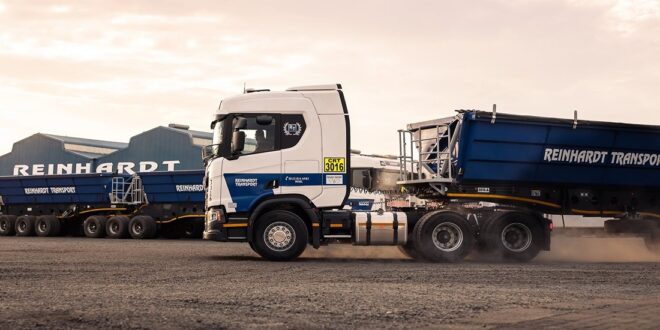
Reinhardt Transport Group, which specialises in transporting bulk commodities such as chrome, coal and manganese, operates across key inland-to-port corridors that underpin South Africa’s export system. Its integrated, corridor-based approach, supported by centralised fleet control, route diversification and long-term partnerships, reflects a broader shift in how logistics is being positioned within the mining value chain. In modern mining, competitive advantage is no longer defined solely at the resource level but along the corridors that connect it to global markets.
